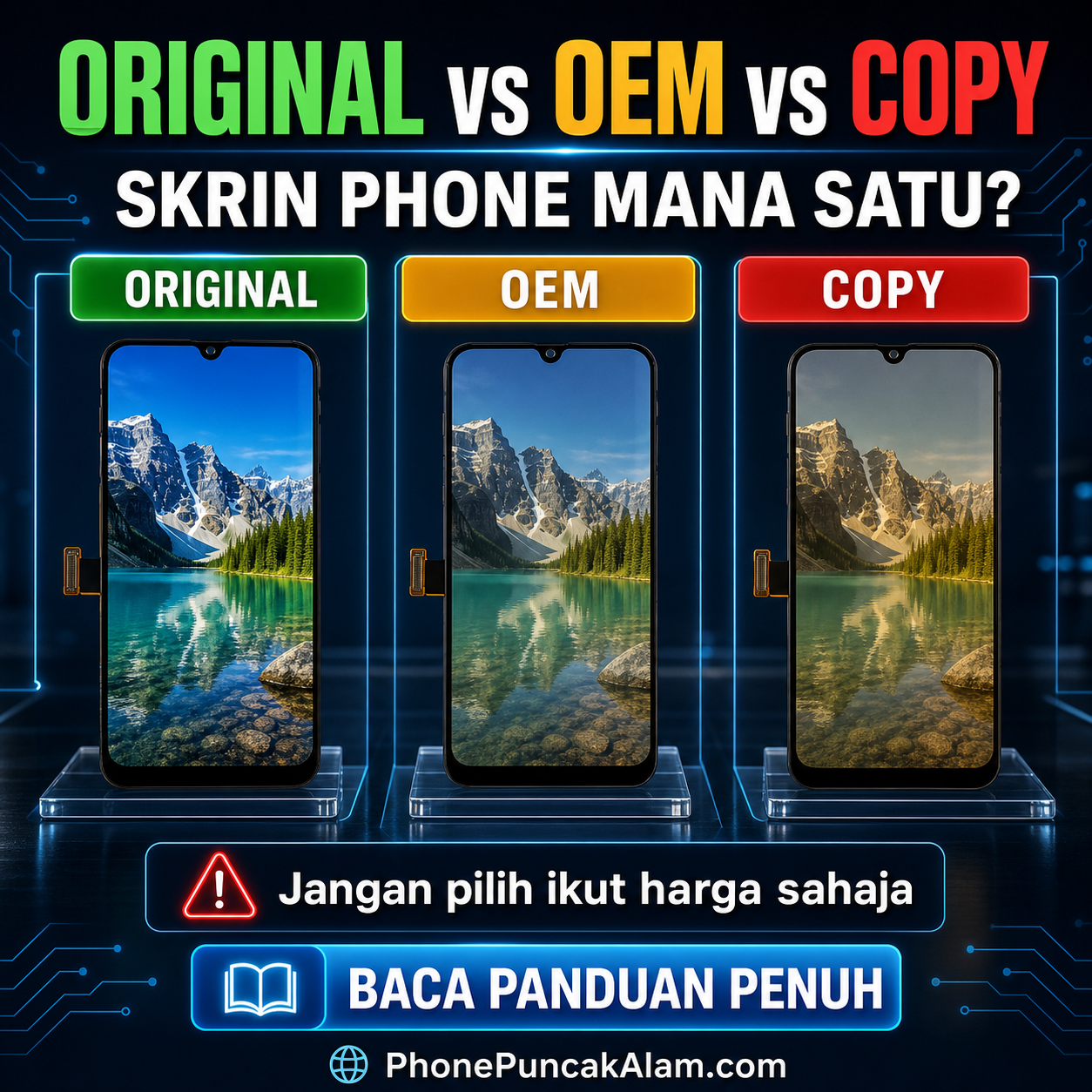
Screen replacement is the most common repair in Malaysia and the one with the widest price spread. Understanding what sits behind that spread is the difference between feeling cheated and making an informed choice — because none of these grades is inherently a scam. Being sold one and told it is another is.
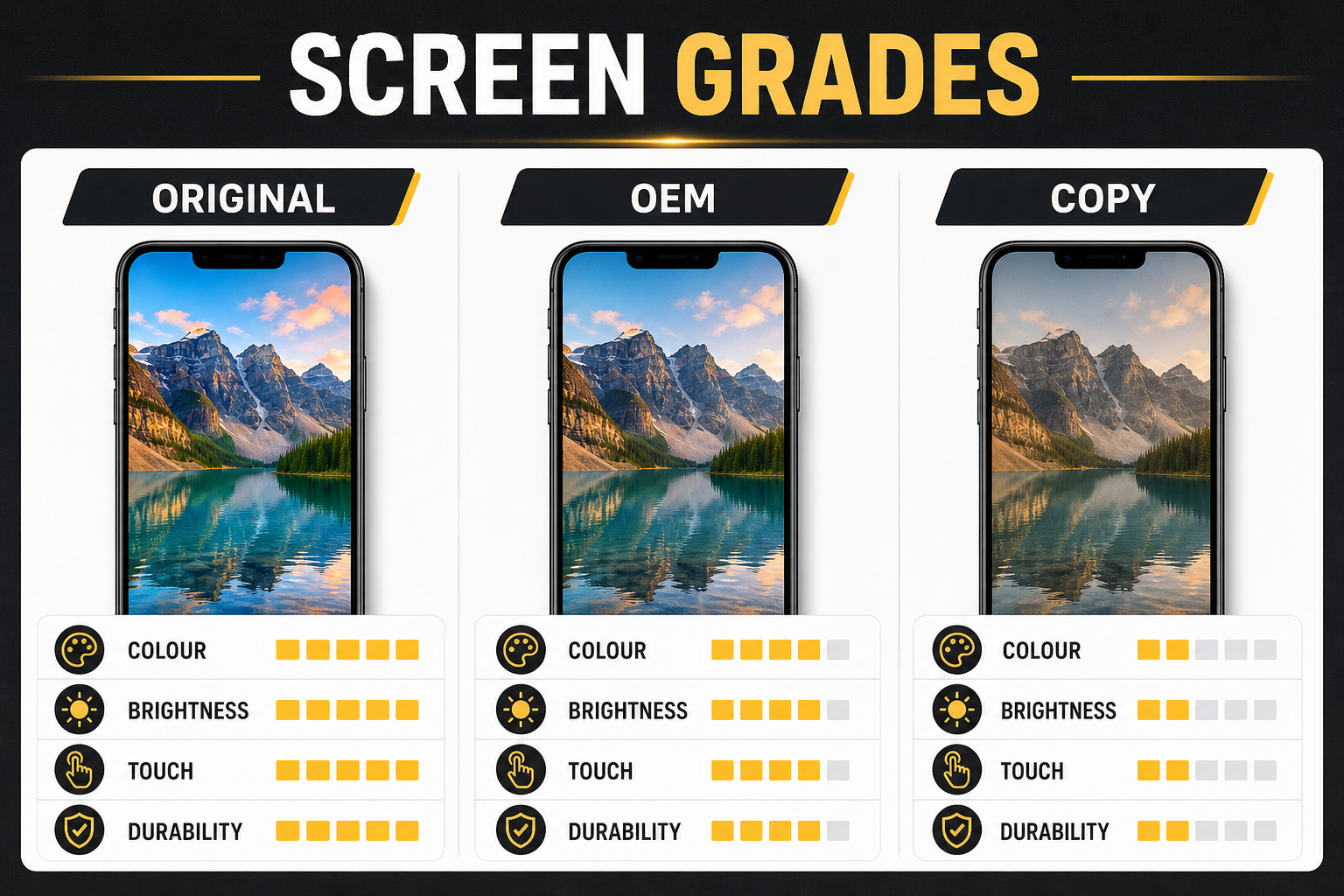
The three grades
Original / service pack
The manufacturer’s own display assembly, supplied through official parts channels. Colour reproduction, peak brightness, touch response and coating are identical to the panel your phone shipped with, because it is the same part. On iPhones and flagship Samsungs this is a substantial premium over the alternatives, and on some models it is not available to independent shops at all.
OEM / “original equivalent”
Panels built to the same specification, frequently on the same production lines, but sold outside official channels. In everyday use most people cannot distinguish a good OEM panel from an original. For the majority of repairs on the majority of phones, this grade is the value sweet spot — close to original quality at a meaningfully lower price.
Aftermarket copy
Third-party panels made to fit rather than to match. On models that originally shipped OLED, the copy is frequently an LCD substitute — which is why the blacks look grey, the viewing angles shift, and the whole screen looks slightly washed out next to the phone you remember. Peak brightness is usually lower, which matters in Malaysian sunlight, touch response at the edges is often less reliable, and the service life is shorter.
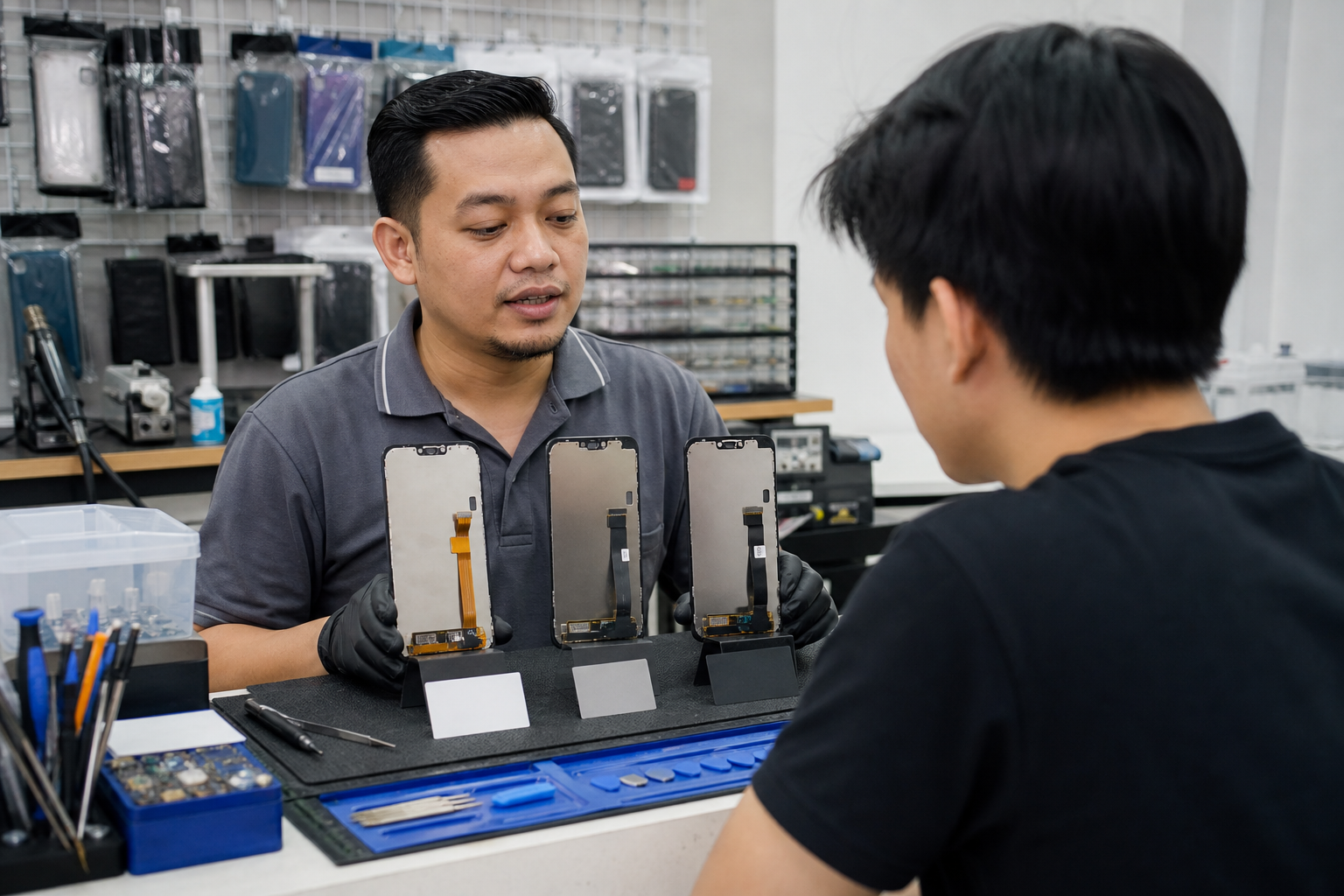
How to tell what you are getting
Ask directly and ask before, not after. A shop that names the grade is being straight with you. Beyond that, there are signals you can check yourself once the phone is back in your hand.
- Look at pure black in a dark room. A true OLED replacement shows black as genuinely off. An LCD substitute glows faintly grey, and you can see the backlight bleeding at the edges.
- Push the brightness to maximum outdoors. Copies are noticeably dimmer in direct sun.
- Swipe slowly along every edge and corner. Copy digitisers commonly lose accuracy in the outer few millimetres.
- On an iPhone, check Settings for a display notice and see whether True Tone still works. Its absence indicates the original display chip was not transferred.
- Look at the white balance against another phone of the same model if you can. Copies often run visibly cooler or warmer.
Which grade should you actually buy?
It depends on the phone’s remaining life, not on principle.
For a recent flagship you intend to keep for years and eventually sell, original or good OEM is worth it — the screen is the thing you look at every waking hour, and a poor panel devalues the device at resale. For a three-or-four-year-old mid-range phone that mainly needs to survive another year, a decent aftermarket panel at a fraction of the price is a rational choice. For a phone you use for work in bright conditions, prioritise brightness and go at least OEM.
What is never rational is paying an original-grade price for a copy. That is the outcome this article exists to prevent, and the way to prevent it is to ask the question before the phone is opened, and to test the panel properly before you leave the counter.
Test before you leave
Take two minutes at the shop. Open a white image and look for uneven patches or pressure marks. Open a black image and check the corners. Swipe every edge. Make a real call to test the earpiece and proximity sensor — if the screen does not blank against your ear, a sensor was not seated. Test Face ID or the fingerprint reader. Check the front camera. It is far easier to raise all of this while you are still standing there.
How to read these listings. PhonePuncakAlam is an independent directory. We publish only the details we could confirm from a shop’s own website, its official social page, or a mapping service — if a field is missing, it means we could not verify it, not that the shop lacks it. We are not an agent for any shop and we do not take a cut of any repair. Prices, turnaround times, parts grade and warranty terms are set by each shop, so please confirm them directly before you hand over your device.
Own one of these shops? Claim or correct your listing — it is free.
Frequently asked
Is an OEM screen as good as the original?
For most users in everyday use, close enough that the difference is hard to spot — which is why OEM is usually the best value. Side by side with an original at maximum brightness, small differences in colour and brightness can sometimes be seen.
Why does my new screen look washed out?
Most likely an LCD panel was fitted to a phone that originally had OLED. That substitution is the most common cause of grey-looking blacks and reduced contrast after a repair. Ask the shop what grade was fitted.
Why did True Tone stop working after my screen replacement?
True Tone depends on data stored in a chip on the original display. Unless that chip is transferred to the new panel, the feature disables itself. Some shops have the equipment to transfer it — worth asking beforehand if the feature matters to you.
More repair guides
How to Choose a Phone Repair Shop in Malaysia: 9 Checks Before You Hand It Over
Independent phone repair in Malaysia is largely unregulated. Anyone can rent a lot, buy a heat gun and open. These are t…
Read the guidePhone Battery Health: When Replacement Actually Makes Sense
Battery health percentages are estimates, not measurements. Here is what actually tells you it is time — and why a swell…
Read the guidePhone Fell in Water? What to Do in the First 30 Minutes
What you do in the first half hour matters more than anything a repair shop can do afterwards. Most of the damage is not…
Read the guideNeed this fixed today?
Compare 27 verified repair shops in Puncak Alam, Shah Alam, Setia Alam, Sungai Buloh and Klang.
Browse repair shops